Antibody-drug conjugates (ADCs) represent a targeted cancer therapy that combines the precise localization of antibodies with the potent killing power of cytotoxic payloads. Their goal is to selectively target tumor cells while minimizing harm to healthy cells. Following Paul Ehrlich’s “magic bullet” concept proposed over 100 years ago, ADCs have come a long way, with 15 ADCs approved by the US FDA as of November 2024. These conjugates are likened to “guided missiles,” comprising three key components: a targeting monoclonal antibody, a cytotoxic drug, and a linker that connects the two.
Advancements in Antibody Engineering: Crafting Smarter Guidance Systems
Within the three key components of ADCs, the monoclonal antibody acts not only as the “navigator” for identifying cancer cells but also as the crucial element ensuring precise drug delivery. To reduce the body’s rejection of non-human antibodies, modern antibody engineering continues to advance. Humanization is a fundamental step, involving grafting the complementarity-determining regions (CDRs) of non-human antibodies into human immunoglobulin. Building upon this, specificity-determining residue (SDR) grafting further enhances the antibody’s affinity for its target while significantly reducing immunogenicity, ensuring the antibody functions more stably and efficiently in vivo.
Crucially, next-generation ADCs are progressively moving away from traditional random conjugation methods. Historically, cytotoxic drugs could randomly attach to any reactive group on the antibody, leading to issues like inconsistent Drug-to-Antibody Ratio (DAR), poor stability, and a narrow therapeutic window. Now, site-specific conjugation technology utilizes genetic engineering to pre-program specific amino acid sequences or short peptide tags on the antibody, allowing drug payloads to precisely attach at predetermined sites and in exact numbers. This technology significantly improves the homogeneity, stability, and pharmacokinetic properties of ADCs, thereby widening the therapeutic window and reducing side effects.
The Intelligent Evolution of Linkers: Precision Control Over Payload Release
The linker, acting as the bridge between the antibody and the drug, has stability and cleavage characteristics that directly determine the efficacy and safety of ADCs. Beyond common cleavable (responding to the tumor microenvironment) and non-cleavable linkers, emerging technologies are revolutionizing payload release:
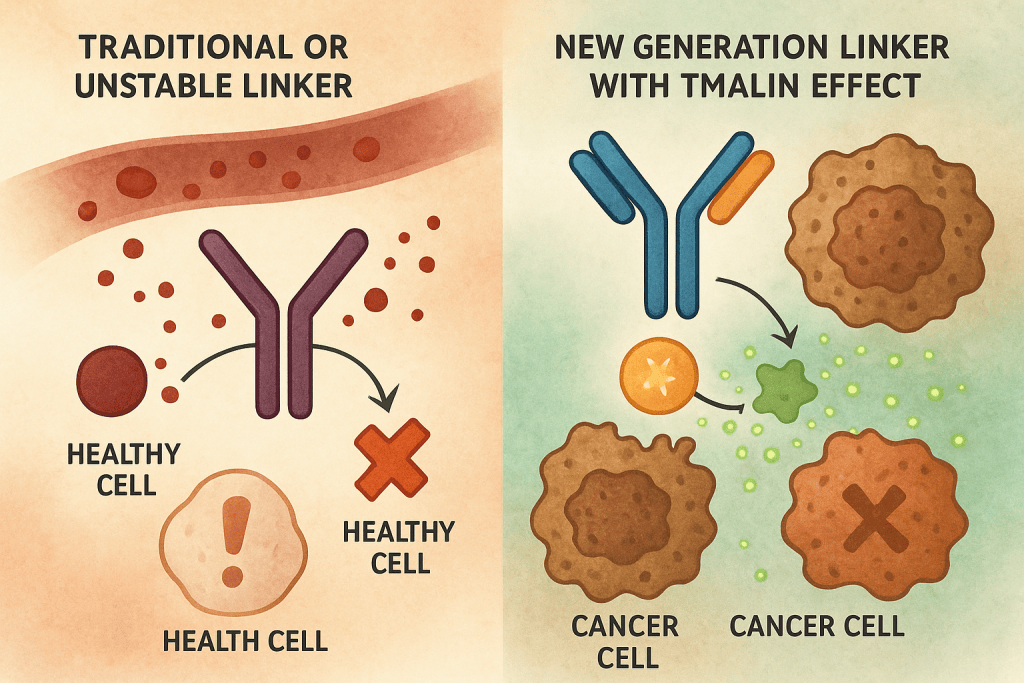
- Tandem-cleavage linkers: These innovative linkers require a two-step enzymatic cleavage to release the drug, significantly enhancing the plasma stability of ADCs. This means the drug is less likely to be prematurely released before reaching the tumor, thereby reducing systemic toxicity and improving targeting efficiency.
- TMALIN™ technology: This groundbreaking linker design allows ADCs to cleave and release drugs extracellularly. This feature vastly expands the range of antibodies that can be selected, enabling ADCs to function even when target antigen internalization efficiency is low. Furthermore, it effectively generates a potent Bystander Effect, where released drugs can kill neighboring non-targeted cancer cells, thus overcoming tumor heterogeneity.
Beyond Single Targets: Dual-Payload and Bispecific ADCs for Tumor Heterogeneity
[cite_start]The high heterogeneity of tumors is one of the greatest challenges in current cancer treatment, often leading to therapeutic resistance and recurrence. To address this, ADC technology is evolving towards multi-dimensional targeting:
- Dual-payload ADCs: These conjugate two different cytotoxic payloads with distinct mechanisms of action onto a single antibody. For instance, combining MMAE (membrane-permeable) with MMAF (a drug efflux pump inhibitor) has shown superior anti-tumor activity in xenograft models. This strategy aims to attack multiple vulnerabilities of tumor cells simultaneously, increasing the breadth and depth of treatment.
- Bispecific ADCs (BsADCs): The antibody component itself possesses two distinct binding sites, enabling simultaneous targeting of two different antigens on tumor cells or different epitopes on the same antigen. This not only significantly enhances the specificity, affinity, and internalization efficiency of ADCs but also addresses the issue of insufficient single-target expression, offering promise for tumor types traditionally difficult to treat with single-target ADCs (e.g., certain MET-expressing cancers.

Expanding Targeting Frontiers: Aiming at the Tumor Microenvironment & Synergistic Therapy
ADC target selection is expanding from directly acting on tumor-associated antigens (TAAs) on cancer cells to targeting tumor microenvironment-associated antigens (TMAs). TMAs are abnormally expressed on non-malignant cells within the tumor (e.g., endothelial cells, stromal cells). By targeting these antigens, ADCs can leverage their bystander effect to kill neighboring non-targeted cancer cells, thereby launching a more comprehensive attack on the tumor mass.
Furthermore, the combination of ADCs with other therapies has emerged as a key strategy to enhance efficacy. Particularly in combination with immune checkpoint inhibitors (e.g., anti-PD-1/PD-L1 therapies), ADCs can kill cancer cells and release tumor antigens, further activating the host immune response and making tumors more visible to the immune system. This synergistic approach promises more effective and less toxic treatment options for patients.
Challenges & Future: Stability, DAR, and Overcoming Resistance
Despite rapid advancements, ADC technology continues to face core challenges. Linker instability can lead to premature drug release and off-target toxicity; and optimizing the Drug-to-Antibody Ratio (DAR) is crucial, as too high a DAR can increase drug hydrophobicity and hepatic clearance, narrowing the therapeutic window.
[cite_start]More complexly, cancer cells can develop various resistance mechanisms, such as reduced target antigen expression, decreased internalization efficiency, or altered lysosomal pH hindering payload release. To overcome these intricate challenges, future research will continue to focus on more precise site-specific conjugation, optimized Fc engineering, and the development of innovative bispecific ADCs and multi-functional payloads, aspiring to ultimately achieve breakthroughs in cancer therapy.
Source: https://www.sciencedirect.com/science/article/pii/S2667005425000432