Antibody-drug conjugates (ADCs) stand as a formidable weapon in contemporary cancer therapy, their success hinging on the precise realization of the “magic bullet” concept. This extends beyond merely identifying the right target and potent payload; the deeper challenge lies in accurately assembling these components to ensure the drug’s stability, efficacy, and safety in vivo. Particularly in the exacting control of the Drug-to-Antibody Ratio (DAR) and the sophisticated chemical design of the linker, next-generation ADC technologies are continually pushing boundaries. The goal is to optimize the therapeutic window, maximize targeting efficiency, and minimize off-target toxicity.
Precision Engineering of Drug-to-Antibody Ratio (DAR): Beyond Conventional Conjugation
Previous summaries have touched upon the importance of the Drug-to-Antibody Ratio (DAR), but this study delves deeper into how to precisely control DAR, a crucial factor for achieving greater homogeneity, stability, and efficacy in next-generation ADCs. Traditional random conjugation methods (e.g., lysine- or cysteine-based conjugation) result in heterogeneous DAR values, creating a varied population of ADCs. This not only affects pharmacokinetics but can also increase toxicity and reduce therapeutic efficacy. To overcome this, the latest technologies include:
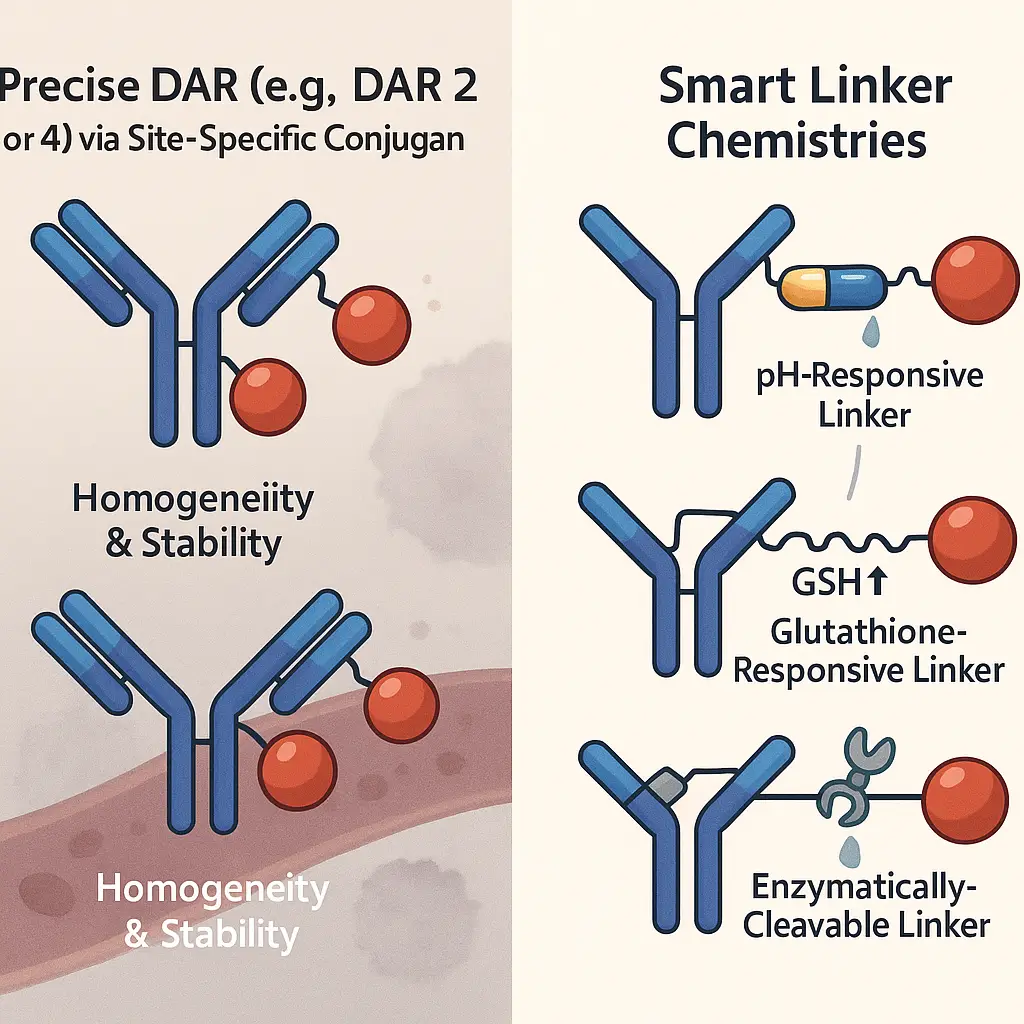
- Refinement of Site-specific Conjugation: This technique goes beyond merely pre-setting binding sites on the antibody. Researchers are now using genetic engineering to introduce non-natural amino acids (such as p-acetylphenylalanine) or specific enzymatic sites (like glycosylation sites), enabling payloads to be conjugated at single sites, with singular conjugation, achieving perfect DAR values (e.g., DAR 2 or DAR 4). This ensures that each antibody molecule carries an exact number of drugs, significantly improving product homogeneity and batch-to-batch reproducibility.
- Hapten-Mediated Conjugation Strategies: This innovative approach involves site-specifically attaching a small hapten molecule to the antibody, after which the payload is conjugated by specifically binding to this hapten. This circumvents the challenges of directly conjugating the payload to the antibody, providing a highly controllable and gentle conjugation mechanism that further enhances DAR precision and conjugate stability.
The Chemical Art of Linkers: Diverse Design Philosophies and Release Mechanisms
The linker is more than just a bridge between the antibody and the drug; it is an intelligent switch that controls the precise release of the drug within the tumor microenvironment. Beyond concepts like cleavable/non-cleavable linkers and TMALIN, this paper extensively explores the diverse design philosophies and chemical structures of linkers and their modes of action:
- pH-Responsive Peptide Linkers: These linkers incorporate specific amino acid sequences that are sensitive to acidic environments. In the acidic conditions of tumor cell endosomes or lysosomes, these peptide chains undergo conformational changes or are specifically cleaved by enzymes, releasing the drug. This design exploits the pH gradient difference between tumor cells and healthy cells to achieve targeted release.
- Glutathione-Responsive Disulfide Linkers: These linkers contain unstable disulfide bonds that are relatively stable extracellularly. When the ADC is internalized into the cell and enters a reducing environment (where intracellular glutathione concentration is much higher than extracellular), the disulfide bonds are reduced and cleaved, releasing the drug. This mechanism ensures drug release within the cell rather than prematurely in the circulatory system.
- Precision in Enzymatic Cleavage Linkers: Beyond simply utilizing lysosomal enzymes, current designs are optimized for enzymes that are highly overexpressed in specific tumor cells (e.g., cathepsin B, plasmin, or specific proteases). This ensures that the drug is released efficiently and specifically only within the target cell and under the correct biochemical conditions.
- The Art of Hydrophilic Linker Design: To counteract the inherent hydrophobicity of certain payloads, next-generation linker designs incorporate hydrophilic groups. This not only enhances the ADC’s solubility in aqueous solutions, reducing aggregation, but also minimizes its non-specific binding in the bloodstream, further reducing off-target toxicity and optimizing pharmacokinetic properties.
Overcoming Heterogeneity and Resistance: Diverse Conjugation Points and Binding Site Strategies
Facing the high heterogeneity and complex resistance mechanisms of tumors, ADC design strategies have also evolved, moving beyond simple dual-payloads or bispecifics:
- Strategic Application of Multi-site Conjugation: While site-specific conjugation for perfect DAR is a goal, in some cases, multiple but controllable conjugation sites (e.g., in different regions of the antibody) can be strategically leveraged. For example, one conjugation site might attach a payload with high internalization efficiency, while another attaches a membrane-permeable payload, to address the varied needs of different cancer cell subpopulations.
- Fine-Tuning Target Binding Epitopes: Beyond targeting different antigens, new antibody engineering techniques allow for modulating the antibody’s binding affinity or mode to different epitopes on the same antigen. This “epitope engineering” can influence the ADC’s internalization efficiency, intracellular trafficking pathways, and drug release kinetics, thereby specifically overcoming issues like insufficient internalization or drug pump-out mechanisms in certain tumors.
- The Potential of “Multivalent” Conjugates: Exploring the conjugation of not just drugs to antibodies, but also multiple antibody fragments or binding domains. These “multivalent” conjugates can simultaneously bind to multiple targets, or bind to a single target with higher affinity, further enhancing targeting capabilities, especially for tumors with low antigen expression.

Future Outlook: The Ultimate in Intelligent Design and Synergistic Effects
Collectively, the in-depth research presented in this paper reveals the developmental trajectory of next-generation ADCs: a shift from mere functional improvements towards ultimate precise engineering and chemical artistry. Exacting DAR control ensures product homogeneity and consistent efficacy; diverse linker chemistry imbues ADCs with the “intelligence” to release payloads in different biological environments. In the future, these technologies, combined with multi-mechanism payloads and tumor microenvironment remodeling strategies, will jointly drive ADCs toward greater breakthroughs in overcoming tumor heterogeneity and resistance, ultimately achieving personalized precision treatment for every patient.
Despite the immense potential of these innovations, challenges remain, including dysregulated immune activation, severe adverse effects, and the intrinsic immunogenicity of some agents. For instance, some immune-stimulating ADCs (ISACs) have faced discontinuation due to unmanageable immune-related toxicity.
However, researchers believe the future of ADCs is intrinsically linked to payload innovation, especially the combination with new targeted agents like PROTACs, which is expected to result in a more active and precise ADC technology. Continued optimization holds the promise of refining cancer treatment and improving patient outcomes.
Source: https://molecular-cancer.biomedcentral.com/articles/10.1186/s12943-024-02024-9